

Labour Day Seminar on Child Labour and Strengthening Child Protection in Bihar
Labour Day Seminar on Child Labour and Strengthening Child Protection in Bihar
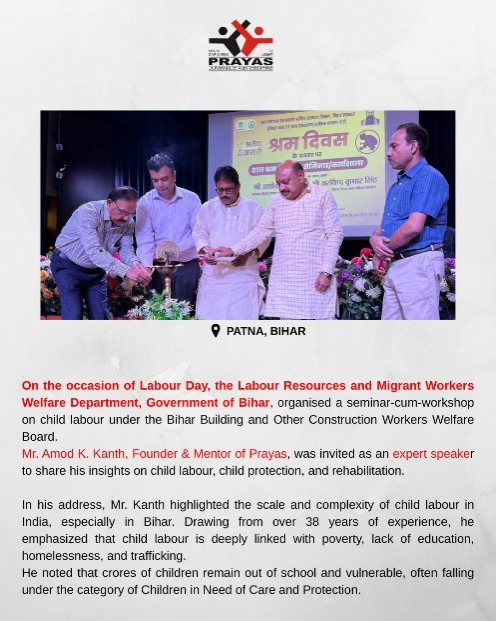
A programme was organised by the Labour Resources and Migrant Workers Welfare Department, Government of Bihar, under the Bihar Building and Other Construction Workers Welfare Board, on the occasion of Labour Day. It featured a seminar-cum-workshop on child labour, highlighting the Department’s focus on child protection and welfare. Mr. Amod K. Kanth, Founder and Mentor of Prayas, was invited as an expert to deliver an address, where he shared his insights on child labour, protection, and rehabilitation.
Address by Mr. Amod K. Kanth
Mr. Amod K. Kanth delivered a detailed address highlighting the scale, complexity, and urgency of addressing child labour and child protection in India, with a particular focus on Bihar. Drawing from the 38-year experience of Prayas, he outlined its extensive work with children in need of care and protection across 12 states, including large-scale outreach, rehabilitation, and skill development initiatives. He emphasized that child labour must be understood within a broader context of socio-economic deprivation, noting that crores of children in India remain out of school and vulnerable, often overlapping with categories such as “Children in Need of Care and Protection.”
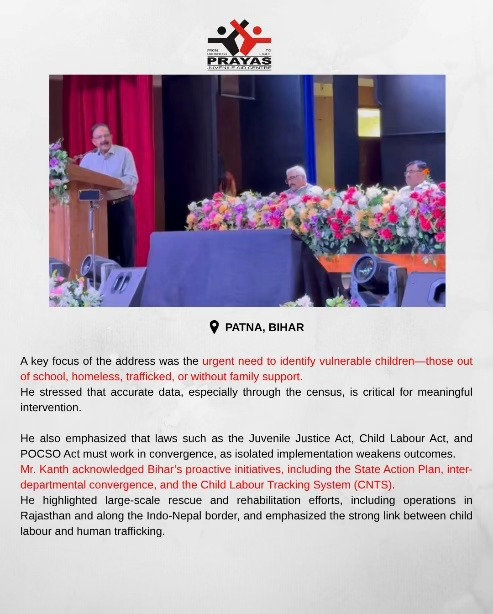
Identification & Legal Convergence
A key theme of his address was the urgent need for systematic identification of vulnerable children — those who are out of school, homeless, trafficked, or without family support. He stressed that without accurate data, particularly through the upcoming census, meaningful intervention would not be possible. He also underscored that multiple legal frameworks governing child protection, such as the Juvenile Justice Act, Child Labour Act, POCSO Act, and others, must be implemented in convergence, as isolated application weakens their effectiveness.
Bihar’s Proactive Efforts
Mr. Kanth acknowledged Bihar’s significant challenge in terms of child labour prevalence but also commended the state’s proactive efforts, including the State Action Plan, inter-departmental convergence across 18 departments, and innovations such as the Child Labour Tracking System (CNTS). He highlighted the importance of strengthening national mechanisms like the PENCIL Portal and welcomed the revival of Special Residential Training Centres.
Field-Level Interventions
Referring to field-level interventions, he cited large-scale rescue and rehabilitation efforts, including operations involving thousands of children from Rajasthan and along the Indo-Nepal border, demonstrating the importance of coordinated action among multiple departments. He emphasized that child labour and human trafficking are deeply interconnected issues and must be addressed together within both policy and implementation frameworks. He also noted the role of financial support mechanisms such as the Chief Minister’s Relief Fund in aiding rehabilitation.
Child labour and human trafficking are deeply interconnected — they must be addressed together within both policy and implementation frameworks.
Policy & Legislative Challenges
The address also drew attention to policy and legislative challenges, particularly the distinction between children and adolescents under labour laws, which creates practical difficulties in enforcement given that most legal frameworks define a child as below 18 years. He noted the transition of the National Child Labour Project into broader schemes like Mission Vatsala, calling for integrated and strengthened implementation through existing institutional mechanisms, especially the Juvenile Justice system. Citing recent data, he pointed to the continued prevalence of child labour, trafficking, and crimes against children, while highlighting gaps in enforcement despite the presence of strong legal provisions.
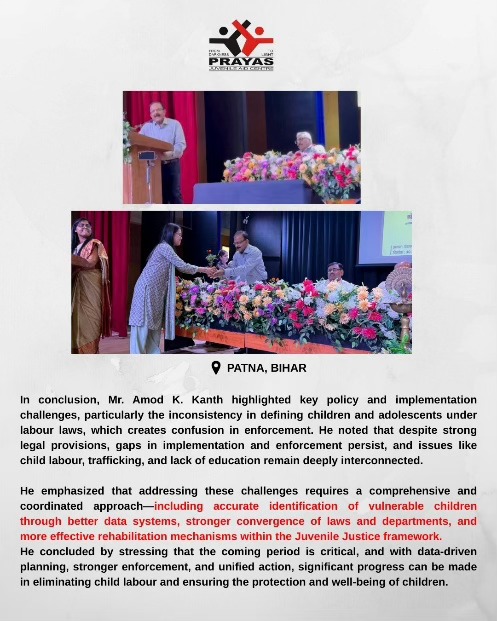
Conclusion
Concluding, Mr. Kanth emphasized that the challenge of child labour requires a comprehensive and coordinated approach involving accurate identification of children, convergence of legal and institutional frameworks, strengthened rehabilitation systems, and improved enforcement. He underlined that the coming period presents a critical opportunity to address these issues more effectively, particularly through data-driven planning and implementation in Bihar.